Libraries Around the World

While editing a book recently, I came across a reference to the Library at Alexandria. So, I looked it up. It must have been magnificent.

LIBRARY-OF-ALEXANDRIA

This led me to looking up other libraries in the world, such as this, at Trinity College, Dublin.

trinity-college-library-university-of-dublin

And this, the University of Salamanca Library, in Salamanca, Spain.

library2

And then, I came across this, El BiblioBurro in Colombia:

Biblioburro

I found the image on the Polis blog, and was thoroughly enchanted by the human drive for knowledge and entertainment. According to the blogger, Natalie Echeverri, “Luis Soriano, the creator of this mobile library, travels every weekend eight hours and up to 11 kilometers in the most remote landscapes of rural Colombia. His goal is to fight what he calls ‘the farmers’ ignorance.”

Throughout much of the world, ornate libraries such as those above are simply not possible. In these countries, the mobile library is still king. Here are a few more images from Polis blog:

A bookmobile bus in Chile:
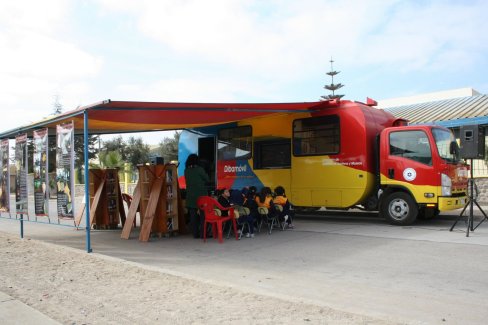
EXPo Museos 005

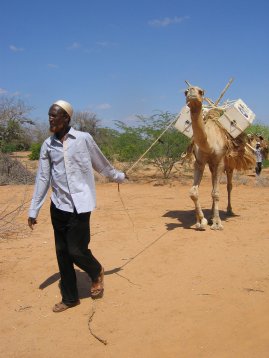
A camel library in Kenya:

camellibrary

camel-books

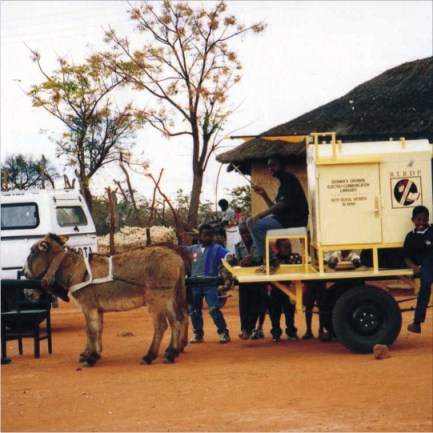
And a donkey library in Zimbabwe:

donkey cart

These folks can’t just order books with a click on Amazon. Nor can they choose from a library of thousands of volumes, but have to make do with what is available to them. I remember reading all of the juvenile fiction books in the library on the Army post at Fort Carson when I was in fifth grade. Once I’d finished reading every book, I started the cycle over. Today, that isn’t a problem: bookstores abound, and any volume I can dream of seems to be available somewhere on the internet.

What heaven such digital access might be to these folks. Ah, but what joy, also, to get a new book in your hands and curl up to read it!
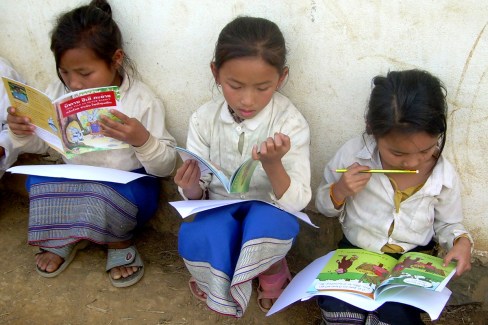
Lao_schoolgirls_reading_books

If you have books that you no longer want or need, I ran across this website, Books for Third World Countries, a not-for-profit organization that will send your books to other countries free of charge. Their goal is to promote literacy across the globe, one book at a time. If you have the books, why not open the world to a new reader?

Brazilian Portuguese Phonetics 101

fiat

Bom dia! (pronounced bohn jee-ah)

Welcome to Brazilian Portuguese Phonetics 101.

Today, we will learn about some of the basic letter sounds of Brazil.

Let us begin. When you see the word, say it aloud. Then (and only after you’ve first said it aloud), read the phonetic pronunciation. Ready? Begin:

dia         (jee-ah)

Haddad  (Ha-da-jee)

tia     (chee-ah)

tio    (chee-oh)

tijela (chee-gel-ah)

tok & stok   (tok-ee stoke-ee)

xicara   (shee-ca-ra)

carro   (ca-hoe)

caro (ca-row)

rio    (hee-oh)

correndo (co-hen-doo)

revista (hay-vista)

baixa (bye-cha)

grand   (gran-jee)

Outback (out-ee-bak-ee)

supraententemente (supra-en-dent-chee-men-chee) … yeah, that one’s a corker!

and a favorite of mine: x-burger (chee-burger)

Think you’ve got it now? Congratulations! Let’s try a couple of easy ones:

Ford   (For-gee)

noite   (noi-chee)

and last, but not least … Fiat    (Fia-chee)

And now, you should be able to speak flawless Brazilian Portuguese (well, you need vocabulary and grammar rules, but that’s the easy part!).

The Darnedest Things

I learn the darnedest things in my job.

I’m currently proofing a college textbook on Biology. Fascinating stuff. Next comes a textbook on Mathematics. I don’t typically edit or proof textbooks; my line is more academic books…books published by professors on their expertise (diplomacy, literature, psychology, philosophy, religion, DIY Indonesia, music of the Fifties and Sixties, etc.).

Every book is filled with new facts and insights for me. That’s why I love my job. The biology book immediately grabbed my attention, with its discussion of Gregor Mendel’s work with genetic inheritance, and an indepth discussion of the workings of mitochondria. Another fun fact was about desert ants and how they navigate back to the nest after wandering for hours and many kilometers in the searing heat.

Experiments showed that the ants don’t use landmarks to navigate, but they do use the relative position of the sun. Plus, they count steps.

The pedometer hypothesis suggests that the ants always know how far they are from the nest because they track the number of steps they have taken and their stride length. The idea is that they can make a beeline back to the burrow because they integrate information on the angles they have travelled and the distance they have gone—based on step number and stride length. It doesn’t matter that they have wandered off on tangents on the trip away from home, because they can calculate a direct-line return.

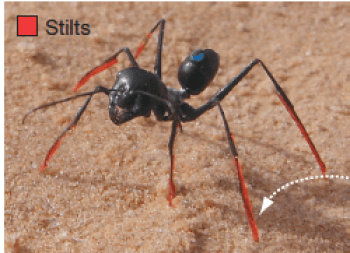
To test this innate ability, scientists created three test cases: the legs of one group of ants were shortened by cutting off the lower segments; the legs of the control group were left as-is, and the legs of the last group were lengthened with the use of  prosthetic “stilts.”

Screen Shot 2012-12-01 at 8.24.53 AM

All of the ants were then released into a 10-meter-long channel and allowed to wander. When it came time to return to the burrow, the control group returned with no problem. But, the group whose legs had been shortened stopped short by about 5 meters before looking for the nest opening, and the group on stilt legs passed the opening by 5 meters. Over time, some were able to recalculate and find their way unerringly to the nest, while almost 50% never made the adjustment. Fascinating!

Okay, so now I place that information in my mental lockbox, and keep it safe for use in my writing at some point in the future. Which brings me to my point: even if you aren’t force-fed new knowledge as I am on a daily basis, as a writer you should make it your task to read outside of your knowledge base. Do the random Wiki reads, or pick up a book of facts and peruse its contents regularly. You never know what you’re going to find that will feed your imagination and give greater depth to your writing.

(For starters, if you’ve never read the short story “Leiningen Versus the Ants,” by Carl Stephenson start there.)