The Darnedest Things

I learn the darnedest things in my job.

I’m currently proofing a college textbook on Biology. Fascinating stuff. Next comes a textbook on Mathematics. I don’t typically edit or proof textbooks; my line is more academic books…books published by professors on their expertise (diplomacy, literature, psychology, philosophy, religion, DIY Indonesia, music of the Fifties and Sixties, etc.).

Every book is filled with new facts and insights for me. That’s why I love my job. The biology book immediately grabbed my attention, with its discussion of Gregor Mendel’s work with genetic inheritance, and an indepth discussion of the workings of mitochondria. Another fun fact was about desert ants and how they navigate back to the nest after wandering for hours and many kilometers in the searing heat.

Experiments showed that the ants don’t use landmarks to navigate, but they do use the relative position of the sun. Plus, they count steps.

The pedometer hypothesis suggests that the ants always know how far they are from the nest because they track the number of steps they have taken and their stride length. The idea is that they can make a beeline back to the burrow because they integrate information on the angles they have travelled and the distance they have gone—based on step number and stride length. It doesn’t matter that they have wandered off on tangents on the trip away from home, because they can calculate a direct-line return.

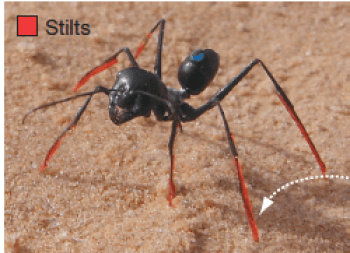
To test this innate ability, scientists created three test cases: the legs of one group of ants were shortened by cutting off the lower segments; the legs of the control group were left as-is, and the legs of the last group were lengthened with the use of  prosthetic “stilts.”
Screen Shot 2012-12-01 at 8.24.53 AM

All of the ants were then released into a 10-meter-long channel and allowed to wander. When it came time to return to the burrow, the control group returned with no problem. But, the group whose legs had been shortened stopped short by about 5 meters before looking for the nest opening, and the group on stilt legs passed the opening by 5 meters. Over time, some were able to recalculate and find their way unerringly to the nest, while almost 50% never made the adjustment. Fascinating!

Okay, so now I place that information in my mental lockbox, and keep it safe for use in my writing at some point in the future. Which brings me to my point: even if you aren’t force-fed new knowledge as I am on a daily basis, as a writer you should make it your task to read outside of your knowledge base. Do the random Wiki reads, or pick up a book of facts and peruse its contents regularly. You never know what you’re going to find that will feed your imagination and give greater depth to your writing.

(For starters, if you’ve never read the short story “Leiningen Versus the Ants,” by Carl Stephenson start there.)

The Moby Dick Big Read

Oh, be still my heart! I just learned today of a project that delights me. It is called the Moby Dick Big Read, and here is written on the site’s About page:

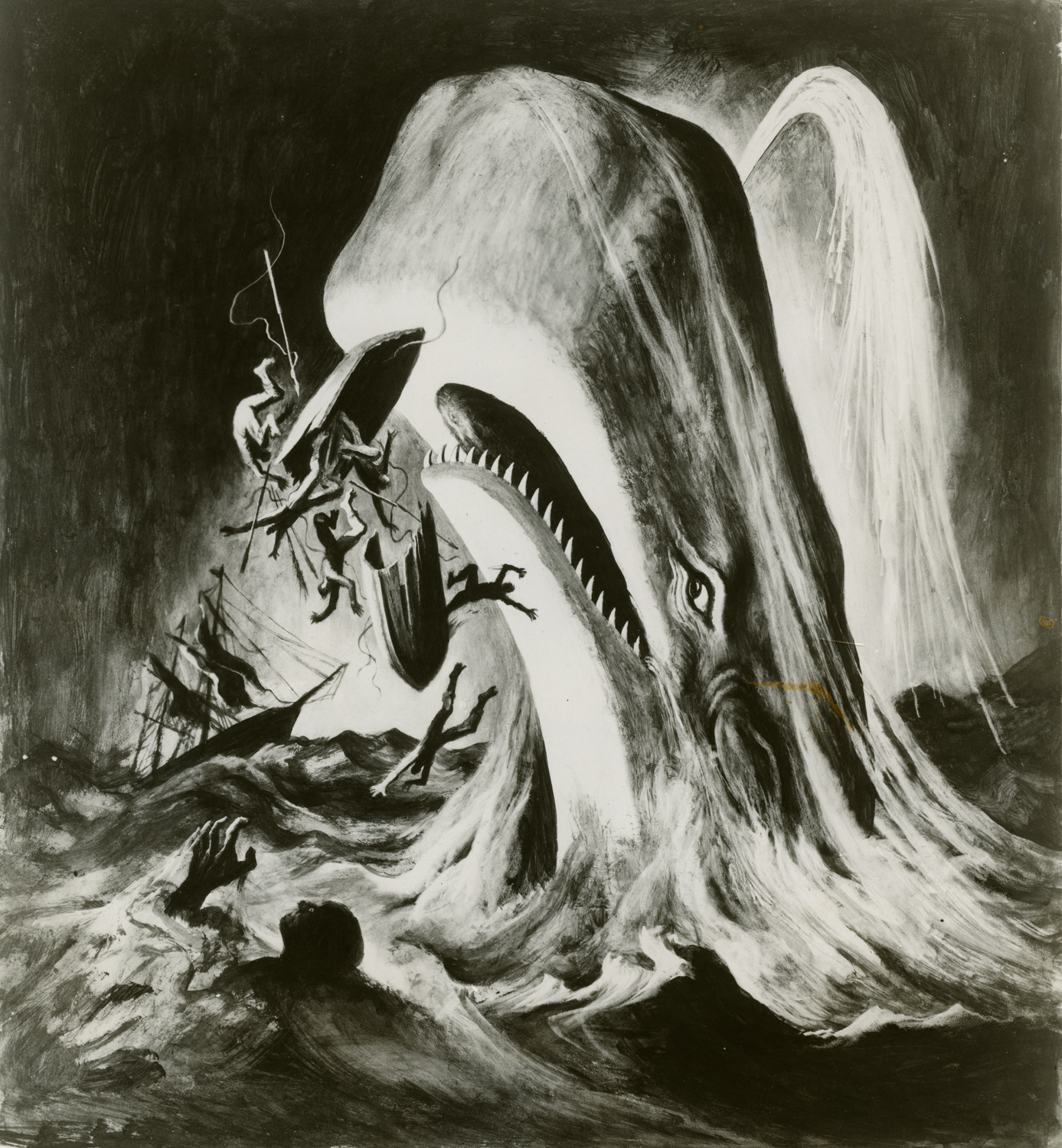
Moby-Dick is the great American novel. But it is also the great unread American novel. Sprawling, magnificent, deliriously digressive, it stands over and above all other works of fiction, since it is barely a work of fiction itself. Rather, it is an explosive exposition of one man’s investigation into the world of the whale, and the way humans have related to it. Yet it is so much more than that. It is a representation of evil incarnate in an animal – and the utter perfidy of that notion. Of a nature transgressed and transgressive – and of one man’s demonic pursuit, a metaphorical crusade that even now is a shorthand for overweening ambition and delusion.

Out of all this, Herman Melville created a unique work of art – as unique as Mary Shelley’s Frankenstein or Emily Bronte’s Wuthering Heights, as mythic as Coleridge’s Rhyme of the Ancient Mariner – a true force of nature, set in a century that challenged every tenet of faith that had been held until then. Melville’s book – is it barely a novel – exceeds every expectation of a literary work. It bursts out of its covers with the enormity of its subject – as if the great White Whale itself were contained within.

Now, in the 21st Century, a century and a half since it was first conceived and launched onto a misbelieving world, Moby-Dick retains its power – precisely because we are still coming to terms with it, and what it said. Incredibly prophetic, it foresaw so many of the aspects of the modern world with which we deal with. The abuse of power and belief; of nature and the environment; of the human spirit. It deals with art and artifice and stark reality – in an almost existential manner. It is truly a book before its time – almost ancient myth, as much as futuristic prophesy.

In the spring of 2011, artist Angela Cockayne and writer Philip Hoare convened and curated a unique whale symposium and exhibition at Peninsula Arts, the dedicated contemporary art space at Plymouth University, under the title, Dominion. Inspired by their mutual obsession with Moby-Dick and with the overarching subject of the whale, they invited artists, writers, musicians, scientists and academics to respond to the theme. The result was an enthusiastic response which evidently could not be contained within the physical restrictions of a gallery space and a three-day symposium.

‘I have written a blasphemous book’, said Melville when his novel was first published in 1851, ‘and I feel as spotless as the lamb’. Deeply subversive, in almost every way imaginable, Moby-Dick is a virtual, alternative bible – and as such, ripe for reinterpretation in this new world of new media. Out of Dominion was born its bastard child – or perhaps its immaculate conception – the Moby-Dick Big Read: an online version of Melville’s magisterial tome: each of its 135 chapters read out aloud, by a mixture of the celebrated and the unknown, to be broadcast online in a sequence of 135 downloads, publicly and freely accessible.

My favorite book. A book I will happily reread time and again, and discuss with whomever, whenever. It is a book about mankind and nature, about the God-filled and the godless, about human interaction and brotherhood, and all about whales. “Call me Ishmael.” Why Ishmael? Why that name exactly? The moment I first asked that question, and set about finding an answer, I became a student of literature. I had always loved books, but Melville opened a new world to me. Where once I read, I now devour.

If you haven’t read this book, listen to it now. Free access! There is no excuse not to step into the labyrinth.

http://www.mobydickbigread.com/

Music As Inspiration

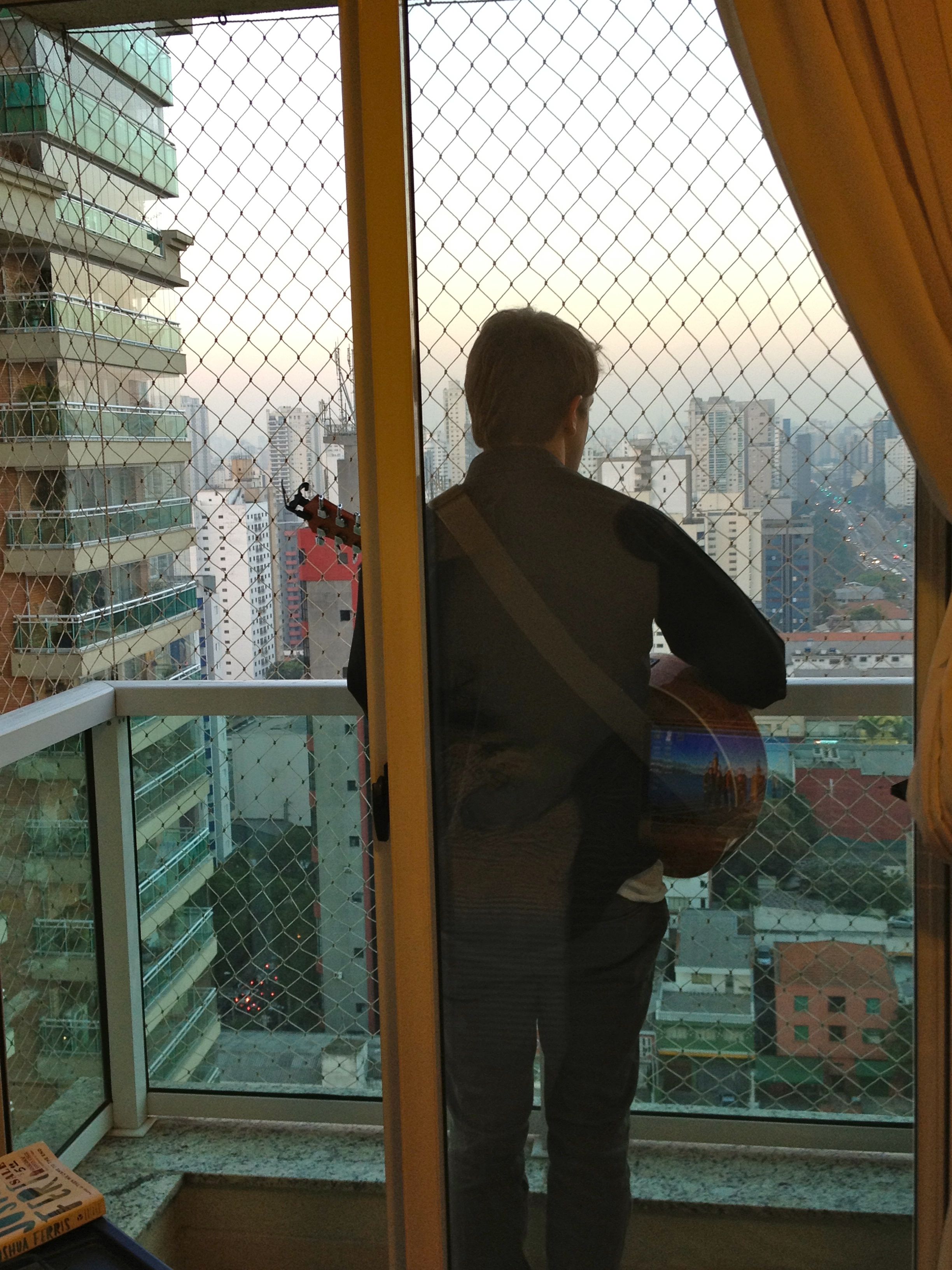
My son is home for the summer, visiting us in Sao Paulo.

These days, I spend the majority of my days sitting in my office chair and editing academic books. Typically, when I edit, the house is quiet, the only sound from within the soft snore of terrier pups, or their bated breathing as they battle over bones (well, antlerz).

From the street sounds the hissing susurration of streaming traffic, punctuated by the peppered peeping of petulant, dyspeptic people on mopeds as they swerve and squeeze around slow-moving sedans.

But with Scott home, my days are made melodious with music. I love the sounds of strumming strings and my scion’s singing as he stands on the veranda, serenading the city scenery! His tempered tenor is truly transporting!

When he’s not singing and playing guitar, the music continues, as he introduces me to new bands and new melodies. I usually can’t concentrate with cacophonous chaos, but his music choices are mellow and mellifluous, so I don’t mind. My own writing is enriched by the influence of these songs, as I listen to the transporting tunes.

Listening to Scott’s own compositions, I am enchanted by his use of language in his lyrics. In the past, I have pooh-poohed some of the people whose music he preferred, proffering my opinion, pronouncing lyrics pedestrian and poor. But not so with his. His lyrics are poetic and pure, punctuating his empathetic personality. Proud parent, perhaps, but picky. He proved his prowess.

When I run dry while writing, I welcome music. I listen to what others have wrought, and I find my own creativity whetted and welling.

Music is a mighty motivator to maintain my momentum when writing.

(Okay, so this is an odd entry; I thought I’d answer a challenge put forth by the WordPress crew. Writing for sound.)

Books That Disappear

A friend sent me this story. I haven’t yet digested the need for such innovation, however.

“Book printed in ink that vanishes after two months

“We’ve seen a few innovations that have offered a twist on traditional reading habits, from offering short works by new authors based on the duration of train delays to a temporary edible book made of pasta and a smokeable book with pages made from rolling papers, printed with the lyrics of rapper Snoop Dogg. Taking elements of both of these ideas, Buenos Aires-based bookshop and publisher Eterna Cadencia has released El Libro que No Puede Esperar – which translates as ‘The Book that Cannot Wait’ – an anthology of new fiction from Latin American authors printed in ink that disappears after two months of opening the book.

“Silk-screened using a special pink ink, the book comes sealed in air-tight packaging that, once opened, allows the printed material to react with the atmosphere. The result is that after two months, the text vanishes. The more the text is exposed to light the faster it disappears, so unread pages may retain the text as long as the reader doesn’t skip ahead in the book. The ink is made from a “secret” formula that is highly reactive with sunlight and air.

“With much discussion currently centering on portable electronic readers and e-books, deemed to be bringing about the death of the physical novel, the creators aimed to add a bit of magic to the anthology, as well as encourage buyers to actually read it once they’ve received it instead of leaving it in their ‘to do’ pile. As the authors inside are all previously unpublished, the concept, developed with help from ad agency Draftfcb, acts as a way to ensure that readers engage with as much of the material as possible while they have the chance. The sense of urgency was important for the publishers to encourage readers to give new authors a chance and force them to digest the content quickly.

“The book has proven popular with Argentinian customers, with the first printed batch selling out on the first day it was put on sale. There is no word from the publishers on what they propose readers should do with the book once the text has vanished — however, leatherbound and with thick pages, it could easily be re-used as a high quality journal, for example.

“El Libro que No Puede Esperar adds an element of urgency to reading — motivating readers, promoting authors and benefiting physical book publishers by creating a buzz around a new release. Is this a business model that is as shortlived as its product, or could this be developed into something more sustainable?”

Ok, so a book that vanishes. I guess that’s okay for an author who isn’t interested in writing the Great American (or French or German or Swahili, etc.) Novel. But even then, to say you’ve written a book that vanishes is almost as bad as saying (as I have twice in the past) that you’ve written a user’s guide to software (which is almost immediately obsolete upon publication).

I know that articles in People magazine are written in lengths that are conducive to the “average bathroom visit,” but books that can be read during the time of an average train delay? What. Is. The. Point? And, weren’t those once called “short stories”? And edible books printed on pasta? Okay, novelty, but why not just print the dictionary on pieces of pasta and let people construct their own pasta prose before consuming? (Hey, I like that idea!) And books written on rolling papers…folks, they get the munchies, not the must-reads!

Still and all, folks will say, at least it’s getting people to read. To which I answer, baloney. (Ah, and there’s another idea!)

“Ode to the Editor” Shared

Finally, in “Ode to the Editor,” someone finally understands what editors actually do, and how we love doing what we do.

Read this to see what I’m talking about. Chuck Wendig is an author who “gets” why an editor is sometimes necessary, and always helpful, even when they “tear apart” an author’s work.

“There she sits, alone. For hours. Maybe days. Pulling pages apart. Seeing what she has. Shining a light into dark corners. Finding sense. Fixing errors. Bringing sanity back to madness, chaos back to order, context back to content. Her red pen dances bloodily upon the page.” Yep, that’s me.

“She goes to him. She shows him what she’s done. He hates her — at first. He froths and kicks and spits, a beast poorly corralled, distraught at what he sees — the ruination of my art, the muddying of my vision, poopy handprints on what was once a clean white wall. But soon he sees. He sees how things make sense.”

“What she brings to the story is hidden behind every page. Lost in the space between sentences. Her repairs are invisible — the mechanisms of her craft hidden behind authorial drywall. Ever unknown to readers.”

I weep. “If you prick us, do we not bleed?” “I am not an animal! I am a human being!”

Thank you, Chuck Wendig. I salute you, as well!

Cockroaches and Science

I am a firm believer that more you read, the better your writing will be. One reason is that if you read good writing, it will somehow be “absorbed” into your psyche, and your inner voice will be accustomed to the rhythms and cadence of good writing, and the proper use of grammar and punctuation. Of course, by reading, I mean reading good writing…the classics, or even respected authors today, both in print and on the Web. It’s a matter of value in, value out, and garbage in, garbage out. It won’t do you any good to read many of the blogs on the net, where ideas are primary and writing is secondary. Oh, read for ideas, by all means, but don’t use these as guides for your own writing.

In that vein, I recommend reading for another reason: to broaden your horizons, which is vital for a writer. Read about people and places you have never experienced first-hand. This is valuable, not because you’ll likely write about those new people and places, but because they will now inhabit your stable of characters and locales, from which you can draw as needed when you write. I’ve just edited a book about memoir writing of Muslim women of the diaspora. Likely, I might never have encountered this subject on my own; I read voraciously, but this wouldn’t have been high on my list. But, as a result of editing the book, I opened my horizons and read on some of the subjects mentioned in the book. As a consequence, my stable of characters has new dwellers.

And then, there are the bizarre facts that you will learn, facts that can later be used to enhance your storyline,  or your characters’ backgrounds. Take this, for instance: cockroaches and science (watch the video at the bottom; fascinating). The subject matter initially repelled me, but I overcame my repulsion and read the article. I’m glad I did! What wonderful ideas now come to mind, for plot lines and interesting ideas for character background.

Read. You have no excuse not to. You may be overworked, but at some point, you must relax. Read. You may live out in the boonies, but if you’re reading this, you have Internet. Read. Prowl among the shelves in libraries and bookstores, pulling out books on topics you might never before have broached. Read. Broaden your horizons, and enrich your writing.

Use a Claude Glass in Your Writing

While editing a book on travel writing (circa 1768-1840), I came across a new term: Claude Glass. Intrigued, I looked it up.

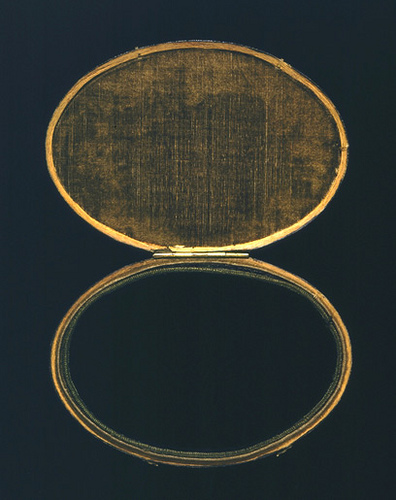
A Claude Glass was basically a slightly convex pocket mirror with a surface tinted slightly dark.  These compact mirrors were used by Picturesque landscape artists as a means of isolating an image, so that it could be rendered independent of anything around it. Thus, fewer distractions, for the artist as well as for the viewer. Black mirrors (as they were also called) have the effect of abstracting the subject reflected in it from its surroundings, reducing and simplifying the color and tonal range of scenes and scenery.

Claude glasses could range in size from pocket-size to much larger, as you can see below.

(This is a drawing in the British Museum by the artist Thomas Gainsborough which shows an artist, possibly a self-portrait,  holding a Claude Glass in one hand and drawing implement in the other, to record what he was seeing in the glass behind him onto the paper on his lap. The Claude glass is named for Claude Lorrain, a 17th-century landscape painter, whose name in the late 18th century became synonymous with the picturesque aesthetic.)

You can even make your own Claude glass by using your side rearview mirror. (Warning, things in the mirror may be larger than they appear!)

So, what does this have to do with writing? Too often, writers (myself included) try to squeeze too much information into a sentence, a paragraph, or any other element of writing. We know so much about our characters, for example, that we want to tell everything about them. We want to tell what they look like, give their background and foretell their futures, or describe in the minutest detail where they are walking and what they are sensing. It’s a case of information overload, sure to prompt readers to toss the book (if they’re anything like me) and run screaming down the hall. Overwriting is sure-death for a story.

That’s where the figurative Claude glass can come in handy, helping you to focus only on what is germane to the moment, and letting all else blend into the edges, into temporary (or permanent) obscurity. My friend Meg Gardiner once accused me of “setting the table” when I started a story: putting everyone neatly in their places, their placards filled with information and aligned at their designated spots. She said I was incapable of just leaping into the action, damn the torpedoes, full speed ahead. She was right. (I have since corrected this habit; I think.)

Essentially, when I write, I must make myself use the Claude glass, identifying what should be in focus, and what should fall by the wayside. When my protagonist is standing in the middle of a mine field, is it absolutely necessary that we know that he is six-foot-four, has blond hair, and plays the cello when not at death’s door? No. His size might be important, but I’d have to determine that as I write. Color of hair? Definitely not. Plays the cello? Only important if the cello figures into his death or rescue. Of course, I must know all of this as the author, but I need to use the Claude glasses to determine what the reader must be told. What matters to the story at this moment?

Clarity of focus. Narrowness of vision. Perception of reality. Thanks, Claude!