Character Descriptions (pt. 2)

When you describe a character (age, height, weight, hair color, ethnicity, clothing, etc.), you are creating a characterization. The characterization is all the surface information that is know about a person (in addition to the above: schooling, social class, employment, etc.).

But the True Character is defined by the choices the character makes under pressure. For example, you can describe a successful businessman who is happily married, has children who are doing well in school and in sports, and who has a world of opportunity still opening before him. You describe him as the kind of guy any team would want on their side, the man you would choose for a neighbor, the fellow who would be selected as the jury foreman.

But what happens to this man when his world falls apart: one of his children is kidnapped, for example. Will he remain calm, focused, in control? or will he fall apart? make rash decisions? put others in harm’s way to help the one?

It is moments like these that define True Character.

When you are creating the characters for your book, start with plot…know who must do what in the story to give it drama, or humor, or suspense. Then people the book, but don’t create cookie-cutter characters, stereotypes…unless you plan to stand those stereotypes on their heads.

Do the unexpected with your characters. Remember the mother-in-law who lives with the successful businessman? The character you may have thought was just filler, rounding out the background for this stand-up guy who even lets his wife’s mother live with them? What if, as he begins to fall apart, she steps forward to lead the way, providing the strong shoulder and clear thinking required in the circumstances?

By the end of the story, we should know the True Character of each of your cast, and none of the primary characters should remain as they started. All must change. That is story. That is character development.

It’s Called a Style Sheet

Yesterday I learned something new. When you copyedit for a publisher, they want you to create something called a Style Sheet as you read. I’ve never done that in the past, not with all the books I’ve edited. At least not officially.

A style sheet is a guide for the proofreader and the editor, listing all of the punctuation, capitalization, abbreviation, and miscellaneous stylistic elements of the book. It also contains a long list of words used in the book, especially foreign words and names, for consistency of spelling.

I’ve kept lists like this when I edit, for my own sanity and edification (especially when I edited the book on Greek history), but never realized that such a thing would be useful to others along the publishing cycle. So, it’s an easy element for me to incorporate into my routine…but why had I never heard of it before?

I sit with the Chicago Manual of Style by my side as I edit because, though my brain is a treasury of grammar and punctuation rules, I sometimes double-think myself and have to verify what I already know.

It’s amazing how organized I feel now that I know about style sheets. I’ll use them for all of my clients now, for their own use and for them to pass along to their publishers.

Learn something new every day.

When Do I Want My Name on the Book?

One of the challenges of being a freelance book editor is abiding by the desires of my clients. I can be engaged as a substantive editor, an organizational editor, a copyeditor, or a proofreader. Each comes with different tasks and a different price tag.

Of course, the more substantive the edit, the higher the cost, so many authors choose the least expensive alternative…often when they shouldn’t. It is difficult, as an editor, to perform mere copyediting when the manuscript cries out for so much more. In this situation, I diplomatically inform my client that I believe the manuscript could be improved with further editing; this is always a dicey task, given that I don’t want to appear to be trawling for more work. Some accept, others decline (always because of the cost).

It has been a challenge to accept the limits on my editing options for some clients. But they know what they can afford. However, given the abysmal state of some texts even after I have done my part, I prefer to not have my name listed as editor.

A case in point. I just finished reading a self-published, and freelance edited, novel. Finding errors like “every legend has some bases in fact” and a seemingly total lack of understanding of the compound past, I immediately checked to see who had edited the text. Given the general state of the writing throughout, I would have left my name out of the credits.

There are some books I point to with pride. Others might never have existed.

Excellence in Writing

I just finished two books over the weekend: Greg Hurwitz’s Crimewriter and Brett Battles’ The Cleaner. Both were gripping and, most importantly, well written. Too often, I find good stories that are poorly written. This seems to be especially common now that publish-on-demand (POD) is so easily available.

I won’t name names, but there are books being sold today that would likely not have seen the light of day had it not been for POD. One of the first giveaways to bad writing for me can be found in most of these books….the self-description by the narrator. These are typically so bad, so “I’ve got to tell them what this character looks like,” that I want to throw the book across the room. Of course, POD authors are not the only ones who are lame at this. Take Dan Brown’s description of Robert Langdon in Angels and Demons. That almost got me to throw the book, but I was laughing so hard I simply dropped it. Pathetic. The guy tells a fun story but he is not a good writer!

That’s the difference with Hurwitz and Battles. Both write extremely well. I was a bit put off by the beginning of Hurwitz’s book. In fact, I put it down for a couple of months before getting back to it. It was a case of “look how well I write,” for me at least. I was too aware of him patting himself on his own back, admiring his description of Los Angeles. I’m glad I worked past that though, because it was an excellent book once I read further. Great story idea and well plotted.

I was hooked on Battles’ book from the first moment: the Cleaner, who goes and cleans up crime scenes for “the Office.” Unique idea and tightly plotted and written.

Both of these authors represent excellence in writing as far as I am concerned. I devoured both books and looked up for more, sateless. Next, however, must be Laurie R. King’s latest book, God of the Hives, and Meg Gardiner’s latest, Liar’s Lullaby. Held off reading King’s book, making myself savor the wait. Now is the time. And as soon as Gardiner’s book arrives, all else must wait.

In Awe

I am in awe of Anthony Horowitz. This man writes some of the most varied and interesting works, from a teenage spy (Alex Rider) to a historical drama (“Foyle’s War”) to modern murder mysteries (“Midsomer Murders”). But it’s not just the variety, it’s what he includes in each of these. It’s the side stories that make me marvel.

For example, in the latest “Foyle’s War,” which, if you haven’t watched them, I highly recommend you add them to your must-see list, the story is about a young man accused of treason during WWII. All well and good, but he is accused of treason for having joined other British soldiers who accepted Hitler’s offer to get out of a prison camp, don the German uniform, and fight against the Russians in the British Free Corps.

There isn’t a great deal said about the British Free Corps, but that is Horowitz’s way. He whets the appetite and it is up to us to read more, to do the research that he has done but which he chooses only to allude to in his story. This isn’t the first time he has done this to me, either. I am forever researching something after I watch one of his shows. That’s what I love about his writing.

Now I am researching the Special Operations Executive and the women spies of WWII. That started because of something Horowitz mentioned about cryptography in one of the shows, which led me to the first digital telephone, used during WWII between Whitehall and the Pentagon, which then led me to the SOE.

My style is to write about what I know. Horowitz’s style is to leak a little about what he knows and then drive us to further research.

If you don’t know his work, I highly recommend him. He has written several children’s books (Alex Rider mysteries among them, written for a woefully under-represented age group), about 50 novels, and numerous television shows. But I warn you, you can’t just read his work and walk away. He WILL challenge you to read more.

Vile Villains Cancel Class

Archvillain Snidely Whiplash

Well, my Vile, Evil Villains class at UCSD Extension was scheduled to begin today, but it was canceled, due to a dearth of students. I was afraid it was too soon to offer it again, and this time as a five-week course (versus three-week last July). So, it’s been postponed until the Winter session. My next classes begin in July: writing memorable characters and overcoming writer’s block. In the fall, I will teach my Writing with the Senses class again. That was a big hit last year.

It’s too bad the Villain class was postponed. I’ve been developing some great new exercises for developing evil villains and the heroes who will oppose them. I got a lot of great insight from Christopher Booker’s tome “The Seven Basic Plots.” If you’re a writer, you have to get this book. It’s joined Sol Stein’s “On Writing” as one of my favorite resources.

But no effort is ever wasted, so I can use much of what I’ve been developing in my Character class.

Meanwhile, I continue with my Memoir Writing workshops every Wednesday. My current students are on their four series of workshops. Some great writing resulting, and, as to be expected, some much-needed therapy. Writing heals.

Hey, that’s a great idea for a new course! Think I’ll go pitch it right now!

The Writer’s Life

As I meet one deadline, writing for St. Mary’s Press, Catholic textbook publishers, I turn now to several other projects that I have lined up. I’m currently editing two academic books, one on Iranian Jewish women immigrants in Los Angeles, and another concerning the women’s plight during the Holocaust, both of which are riveting topics. I am also editing a series of mysteries that take place in the fashion industry of New York City. How’s that for diversity?

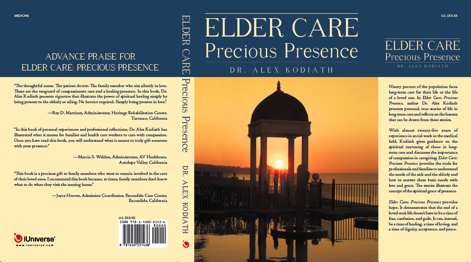
Cover for "Elder Care"

I am also delighted to announce two new publications. Dr. Alex Kodiath’s just-released “Elder Care: Precious Presence,” a book about the healing power of presence in dealing with the elderly and the dying. I edited the book for him. Maria Csanadi, a Hungarian immigrant, just published her memoirs of the family’s escape from Hungary in 1956, in a book entitled “Precious Legacy.” I worked with Maria for several years to help her write the book, and then edited it for her. She is delighted to have finished the book and have it to pass along to family, other immigrants, and any university departments that might be interested in first-hand history of that time.

Cover for "Precious Legacy"

Both books are available online, simply by searching for the titles or the authors in Google.

I enjoy the projects and cannot believe how fortunate I am to earn my living as a writer and editor. The long hours are easy to accept when the work is so diverse and entertaining.