The Writer’s Life

As I meet one deadline, writing for St. Mary’s Press, Catholic textbook publishers, I turn now to several other projects that I have lined up. I’m currently editing two academic books, one on Iranian Jewish women immigrants in Los Angeles, and another concerning the women’s plight during the Holocaust, both of which are riveting topics. I am also editing a series of mysteries that take place in the fashion industry of New York City. How’s that for diversity?
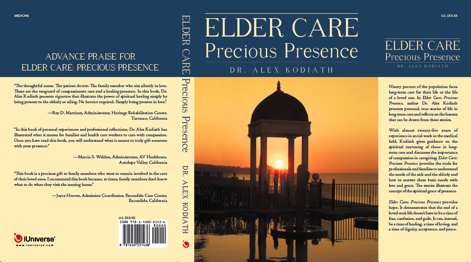
Cover for "Elder Care"

I am also delighted to announce two new publications. Dr. Alex Kodiath’s just-released “Elder Care: Precious Presence,” a book about the healing power of presence in dealing with the elderly and the dying. I edited the book for him. Maria Csanadi, a Hungarian immigrant, just published her memoirs of the family’s escape from Hungary in 1956, in a book entitled “Precious Legacy.” I worked with Maria for several years to help her write the book, and then edited it for her. She is delighted to have finished the book and have it to pass along to family, other immigrants, and any university departments that might be interested in first-hand history of that time.

Cover for "Precious Legacy"

Both books are available online, simply by searching for the titles or the authors in Google.

I enjoy the projects and cannot believe how fortunate I am to earn my living as a writer and editor. The long hours are easy to accept when the work is so diverse and entertaining.

Christian Writers Conference

I just spent Friday night and Saturday at the Orange Country Christian Writers Conference. I have to say, what a great group of people. And, as at the other writer conferences I’ve gone to, the majority of attendees were women, though there were men, as well. I was there in the guise of Editor for Restorative Press, a publishing company I am helping to get started for a dear friend, the Rev. Carmen Warner-Robbins. She is the Publisher, I am the Editor, and Leslie Emmanuel is the Marketing Guru. We will publish books about people who have suffered trauma and successfully overcome it, as a means of encouraging others to work for healing in their lives.

It’s an offshoot of Carmen’s Welcome Home Ministries, which works with women in jail and prison and gives them a hand when they get out, so that they don’t fall into the same spiral that landed them in jail or prison in the first place. When these women successfully turn their lives around, they become peer mentors and reach out to other women whose lives have landed them behind bars. For the majority of these women, prison is simply the last step in a life of abuse, degradation, and hopelessness. Welcome Home Ministries offers these women something they’ve never had before: hope and a helping hand.
We have high hopes for Restorative Press as an avenue for publication of books of hope and healing. I’m proud to be part of the enterprise.

Heroes and Villains

In May, I will be teaching my “Vile, Evil Villains” class again at UCSD Extension. I taught this class last summer for the first time and the course proved so successful that the students rallied to extend it from a three-week class to a five-week class.

The gist of the course is “What makes a hero a hero and a villain a villain?” It’s my belief that villainy follows Newton’s Third Law of Motion: for every action, there is an opposite and equal reaction. A truly evil villain must face off against a truly heroic hero. But both must be flawed, for therein lies the tension. Think how boring Superman would have been without the threat of Kryptonite. Or how evil Snidely Whiplash would be without his love for Pauline. These fundamental, inherent flaws of body or nature are what provide the looming uncertainty: success or failure?

Of course, then there’s the triangle of tension between the hero, the villain, and the Loved One. Oh, so much more to talk about. But we’ll rest here with the fatal flaws.

Memoir Writing

I think one of the greatest legacies a parent can leave for their children is their life story. This is why I teach a memoir writing workshop in the community every Wednesday morning. Yes, I get a small stipend for teaching the workshop, but that isn’t my primary reason for doing it. I get great delight in helping the members of the class to recall their lives and put them down on paper, for family, friends, and others to enjoy.

We are all put down in a running river of life: our families came before us, and more will follow, but we live for a moment in that river, live a life that no one else lives. Our lives are worth recording, if only to preserve our memories. But there is another reason: our lives will never be repeated. Our times will never be repeated. So often, I have to tell members in my class that people no longer know about things that were commonplace in their lives: from one-room schoolhouses to automated cafeterias, to chokes on cars or “pinning” your girl.

Each life is unique and each should be captured on paper. Not all must be published, but they should be shared. Future generations will enjoy these personal snapshots of life.

Left Coast Crime Conference, Review

Well, the 2010 Left Coast Crime Conference has come and gone, and what a great affair it was. I got to meet and speak with one of my favorite authors, Laurie R. King, who graciously bought me a whiskey one evening (I threatened to keep the glass but settled for the napkin as a memento). I met and hobnobbed with several other authors, including some of the “freshmen” class who were there marketing their first novels. And, best of all, I had days to hang out with Meg Gardiner, creator of Evan Delaney and Jo Beckett, talking writing, novels we’ve read, and really bad movies we’ve seen. It doesn’t get much better than that.

Also spoke on the “Social Commentary” panel, which started out a little rocky but quickly developed legs of its own and took off to a splendid end, if we do say so ourselves.
While I thoroughly enjoyed the four-day event, the proof of its worth will come in any contacts I made for my editing business. I put out plenty of business card and many, many of them disappeared into peoples’ pockets…so we shall see.

Meanwhile, raring to go on working on my own novel(s).

Left Coast Crime Conference Panel, part 2

So, on March 11-14, I will be attending the Left Coast Crime Conference in Los Angeles, where I will soak in the atmosphere of mystery writing par excellence. Some of my favorite writers will be there: Laurie R. King, Lee Child, Robert Crais, and that up-and-coming star, Meg Gardiner.

I have been invited to participate on the panel “Social Commentary,” which I anticipate eagerly. The others on the panel are mystery writers, while I, though working on a mystery but as yet unpublished as a novelist, will sit as an editor. And I believe I’ll have some beneficial insights for those writers who attend the workshop. Social commentary is welcome in fiction, but only when it doesn’t overwhelm the story and when the reader doesn’t come away feeling “preached at.” That’s my humble opinion, anyway.

Should be a fun and illuminative weekend. More later.

What Authors Really Want

Most authors recognize that in order to get published today, a manuscript must be edited and prepared for publication before it is ever sent for consideration. Most publishers today do not have the staff, the time, or the money to edit a book once it has been accepted, unless, of course, you are one of the elite authors for whom such things are still the norm.
That said, most authors understand that they must have another eye critique and edit their work before it is sent off to a publishing house.

What many authors don’t understand, however, is that an editor’s job is not simply to rave about the work, declare it ready to go, and fix a few spelling and punctuation errors. Any editor worth paying will read the book with a critical eye and provide honest feedback. Editors should not be hired as ego strokers. It is our job to look at the work and find ways to improve it, ways that would be readily apparent to any reader at any decent publishing house.

As a writer, I know how hard it is to put my work out for review, after I’ve slaved over every sentence, nuanced every line, and agonized over the structure, plot, and storyline. But I also know that when I do have other, knowledgeable readers critique my work, I am able to improve my writing in ways that weren’t readily apparent to me.

As an editor, I have frequently encountered those authors who truly want my professional opinion and suggestions. These are the delightful clients, ones for whom I am willing to put in longer hours and more effort. But there are a few authors who seek my advice and then get indignant when I make suggestions for improvement. For these authors, their works are their children, and how dare I criticize what they have created. These are the authors from whom I know I should run, because neither of us will be satisfied: not them with my editing, and not me with their final product.

But that’s what makes the world go round. Me, with my opinions, and they, with theirs. As an editor, I have to realize that I cannot always edit a work to my vision, but must accommodate the author’s vision first and foremost, but only after I have given my honest opinion, assessment, and suggestions.