The Darnedest Things

I learn the darnedest things in my job.

I’m currently proofing a college textbook on Biology. Fascinating stuff. Next comes a textbook on Mathematics. I don’t typically edit or proof textbooks; my line is more academic books…books published by professors on their expertise (diplomacy, literature, psychology, philosophy, religion, DIY Indonesia, music of the Fifties and Sixties, etc.).

Every book is filled with new facts and insights for me. That’s why I love my job. The biology book immediately grabbed my attention, with its discussion of Gregor Mendel’s work with genetic inheritance, and an indepth discussion of the workings of mitochondria. Another fun fact was about desert ants and how they navigate back to the nest after wandering for hours and many kilometers in the searing heat.

Experiments showed that the ants don’t use landmarks to navigate, but they do use the relative position of the sun. Plus, they count steps.

The pedometer hypothesis suggests that the ants always know how far they are from the nest because they track the number of steps they have taken and their stride length. The idea is that they can make a beeline back to the burrow because they integrate information on the angles they have travelled and the distance they have gone—based on step number and stride length. It doesn’t matter that they have wandered off on tangents on the trip away from home, because they can calculate a direct-line return.

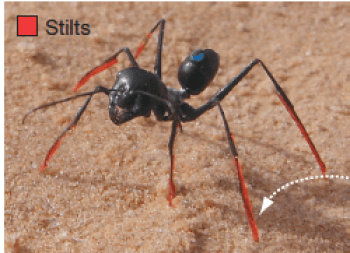
To test this innate ability, scientists created three test cases: the legs of one group of ants were shortened by cutting off the lower segments; the legs of the control group were left as-is, and the legs of the last group were lengthened with the use of  prosthetic “stilts.”
Screen Shot 2012-12-01 at 8.24.53 AM

All of the ants were then released into a 10-meter-long channel and allowed to wander. When it came time to return to the burrow, the control group returned with no problem. But, the group whose legs had been shortened stopped short by about 5 meters before looking for the nest opening, and the group on stilt legs passed the opening by 5 meters. Over time, some were able to recalculate and find their way unerringly to the nest, while almost 50% never made the adjustment. Fascinating!

Okay, so now I place that information in my mental lockbox, and keep it safe for use in my writing at some point in the future. Which brings me to my point: even if you aren’t force-fed new knowledge as I am on a daily basis, as a writer you should make it your task to read outside of your knowledge base. Do the random Wiki reads, or pick up a book of facts and peruse its contents regularly. You never know what you’re going to find that will feed your imagination and give greater depth to your writing.

(For starters, if you’ve never read the short story “Leiningen Versus the Ants,” by Carl Stephenson start there.)

“Ode to the Editor” Shared

Finally, in “Ode to the Editor,” someone finally understands what editors actually do, and how we love doing what we do.

Read this to see what I’m talking about. Chuck Wendig is an author who “gets” why an editor is sometimes necessary, and always helpful, even when they “tear apart” an author’s work.

“There she sits, alone. For hours. Maybe days. Pulling pages apart. Seeing what she has. Shining a light into dark corners. Finding sense. Fixing errors. Bringing sanity back to madness, chaos back to order, context back to content. Her red pen dances bloodily upon the page.” Yep, that’s me.

“She goes to him. She shows him what she’s done. He hates her — at first. He froths and kicks and spits, a beast poorly corralled, distraught at what he sees — the ruination of my art, the muddying of my vision, poopy handprints on what was once a clean white wall. But soon he sees. He sees how things make sense.”

“What she brings to the story is hidden behind every page. Lost in the space between sentences. Her repairs are invisible — the mechanisms of her craft hidden behind authorial drywall. Ever unknown to readers.”

I weep. “If you prick us, do we not bleed?” “I am not an animal! I am a human being!”

Thank you, Chuck Wendig. I salute you, as well!

Do Do That Voodoo That You Do So Well

I’m struggling to learn Portuguese right now. I study my Aquarela book every day, and at night if I watch TV, I watch with Portuguese subtitles on. I’m amazed by how many words I already know, and by how many are similar to words in English or French or Spanish. My reading is going well, but my speech is slower, and my understanding when hearing the language spoken is still lamentable.

I’ve learned to say “No falo português,” and more recently, “Aprendendo português ainda, por favor fala mais devegar” (I’m still learning Portuguese, please speak more slowly).

It’s not a difficult language; there’s just a lot to learn. I speak French, know some German, and can understand Spanish and some Italian. I suppose I have a facility for language, and I love the richness and diversity of the English language.

I’ve heard that English is difficult to learn, and remember Ricky trying to learn the rules from Lucy on “I Love Lucy.” (It’s cough, as in coff, but through as in thru?)

Last weekend, our taxi driver told us he found learning English was incredibly difficult. I said I was a bit surprised, since the structure of the language is the same (unlike German, where the verb goes at the end of the sentence) and many of the words are similar, if not identical. But it wasn’t structure or vocabulary that troubled him. It was the word “do.”

Do you like pineapples? I do. What do you do? How do you do? Do you understand?

In other Latin-based languages, you don’t (do not) have an equivalent. One asks the equivalent of: you like pineapples? Yes, I like them. What is your job? How are you. You understand? There is no “do” in those phrases. I’d never thought of that.

No only is the function of the word a mystery, but you must also now conjugate two verbs in a single sentence: What do you do? What does he do (not does)? How do you (plural) do.

And then there is the use of the affirmative, and negative in English compared to Portuguêse.

Do you speak English? I do/I don’t.

Do you speak Portuguese? I speak. I no speak.

Do you like hamburgers? I do.

Do you like feijoada (a Brazilian bean dish)? I like/I no like.

Who know that this do had such voodoo? A simple two-letter word had brought this man to his knees, figuratively speaking.

Cyber Books Don’t Stick

For the past year, I’ve been reading most of my books on the Kindle or iPad. It’s just so handy to carry my library with me that way, and the books (while not cheap, as if digital printing costs a lot) are less expensive.

Plus, when we moved at the end of the year, I had to give away half of my carefully accrued library, which bruised my soul. So, I figured, fine, I’ll just get books online now.

(That photo shows one of three trips I made to give books to the local library.)

But I’ve discovered something interesting. I don’t retain the books I read online nearly as well as I do printed books, and I’m not talking possession. I’m talking in my brain. When I try to recall the ebooks I’ve read in the past year, I have a vague recollection of the story and plotline, but most of the particulars are hazy. On the other hand, when I try to recall books I’ve read on the page, they seem to stick with me. Fact.

I read somewhere that the human brain doesn’t retain as much when the print is digital versus ink. I’ll have to look for those articles again, because I think I’m living proof of that truth. eBooks are definitely more convenient, but I think I’ll reserve eBooks for those quick reads (the Lee Child books), and save actual printed books for those I want to savor and enjoy again and again (PD James, Meg Gardiner, Laurie R. King, C. S. Forester, etc.).

Of course, that means I’ll rebuild my library, but I must. It’s part of who I am. I’m a reader and a writer. I own books. I love books. I need books.

Brave New Words Coming Soon

According to National Geographic magazine, there might soon be some words added to the venerable Oxford English Dictionary. Yes, languages are living entities and should change over time. It appears that the time has arrived, again.

According to NatGeo, “Wide, long use is key….Fresh words or meanings are added to a database and their usage is tracked for up to ten years. If [the word] ‘cankle,’ for instance, pops up often enough [in books, magazines, newspapers, and various online sources], it may be one of the 4,000 words–out of 6,000 considered–that make the cut each year. Then it will be here to stay.”

Among the words being considered are:

beer jacket: the supposed insulating effect created by being drunk

cankle: thick ankle

earworm: a catchy tune that gets stuck in your head

face palm: an expression of exasperation or disbelief (palm goes to face)

guy liner: eyeliner for men

wibble: the trembling of the lower lip just shy from actual crying

xenolexica: a state of grave confusion when faced with unusual words

As a wordsmith, I particularly enjoy the last one! As a writer who tries to stay current, I realize that I need to keep tabs on today’s living language. It’s getting harder and harder, as new technology forces new words into our living lexicon. But I try to stay relevant. And now, I shall dip.

The Power of Words

Today, there are so many people–politicians, actors, athletes, university presidents, etc.–who stand before their audiences and pontificate on whatever subject is near and dear to them. So many times, my eyes just glaze over as I try to listen, generally because they beat an idea to death, and use too many words to do it. It’s not simply a matter of telling your audience what you’re going to say, saying it, and then telling them what you said. That is painful enough, but they also have to repeat the ideas from several view points, just in case you missed it the first time.

Then I read some of the great speeches of the past. George Washington’s Farewell Address of 1796 comes to mind, an excerpt of which I quote:

“I have already intimated to you the danger of parties in the State, with particular reference to the founding of them on geographical discriminations. Let me now take a more comprehensive view, and warn you in the most solemn manner against the baneful effects of the spirit of party generally.

“This spirit, unfortunately, is inseparable from our nature, having its root in the strongest passions of the human mind. It exists under different shapes in all governments, more or less stifled, controlled, or repressed; but, in those of the popular form, it is seen in its greatest rankness, and is truly their worst enemy.

“The alternate domination of one faction over another, sharpened by the spirit of revenge, natural to party dissension, which in different ages and countries has perpetrated the most horrid enormities, is itself a frightful despotism. But this leads at length to a more formal and permanent despotism. The disorders and miseries which result gradually incline the minds of men to seek security and repose in the absolute power of an individual; and sooner or later the chief of some prevailing faction, more able or more fortunate than his competitors, turns this disposition to the purposes of his own elevation, on the ruins of public liberty.

“Without looking forward to an extremity of this kind (which nevertheless ought not to be entirely out of sight), the common and continual mischiefs of the spirit of party are sufficient to make it the interest and duty of a wise people to discourage and restrain it.”

Are we not living today this very conflict of which Washington spoke? And how succinct was his warning. What politician or pundit today could be so powerful, so forceful, in so few words?

And then we have Abraham Lincoln, who wrote almost in sound bites, his wisdom thus easily recalled, as in the Gettysburg Address:

“Four score and seven years ago our fathers brought forth on this continent, a new nation, conceived in Liberty, and dedicated to the proposition that all men are created equal.

“Now we are engaged in a great civil war, testing whether that nation, or any nation so conceived and so dedicated, can long endure. We are met on a great battle-field of that war. We have come to dedicate a portion of that field, as a final resting place for those who here gave their lives that that nation might live. It is altogether fitting and proper that we should do this.”

Or Mohandas Gandhi, speaking of Christianity:

“A man who was completely innocent, offered himself as a sacrifice for the good of others, including his enemies, and became the ransom of the world. It was a perfect act.”

Who do you know today who speaks with such clarity and simplicity?

I have been editing two books recently, one a work of fiction and the other of non-fiction. Worlds apart in subject and in writing style. The fiction book would be better as a screenplay, since the novelist writes dialogue better than he writes narrative. But both are blessedly brief. He doesn’t overwrite (except when he uses a thesaurus instead of his own vocabulary, which then brings the author into the story…which is a major blunder).

The non-fiction writer is writing a theology book, and with each sentence was attempting to address every possible argument that sentence. It was extremely draining to try to read. I understood his reasons, but was able to convince him that his sentences were too dense, that if he ever hopes to have the tome read completely, he had to lighten the load of every sentence. Taking my advice, he edited and pared, and the result has been striking. His insights leap off of the page now, freed from the burden of unnecessary words.

As you write, read. Read literature and famous speeches, and notice how the authors have made their language work for them. As Mark Twain said, write as though you must pay for the words you use. A typical Twain thought, carved to the bone and yet full-figured:

“Anger is an acid that can to more harm to the vessel in which it is stored than to anything on which it is poured.”

Portuguese to Expand My Vocabulary

So now that I will soon be moving to Sao Paulo, Brazil, I have to learn Portuguese. I already speak French, know some German, and understand Spanish, but I hear that Portuguese is a whole new kettle of fish.

I’m looking forward to learning it, though, because each language I learn increases my English vocabulary, since English is a compilation of Romance languages, Latin languages, and a whole collection of words from other languages. Plus, as I learn Portuguese, I’ll learn new ways to phrase and describe things, rather than simply translating English into Portuguese. Transliteration doesn’t always work, as JFK found out while standing at the Berlin Wall, stating in German, “Ich bin ein Berliner.” What he meant was, I am a citizen of Berlin, but what he said was, I am an eclair. Or my father, when he once stated, “Je suis embarrasse,” to a roomful of nuns, who laughed behind their hands in silent hilarity. What he meant was, he was embarrassed. What he said was, he was pregnant.

So, it’ll do me good to learn a new language, both to apprehend what people in Brazil are saying to me, but also to expand my English vocabulary and descriptions. As I study, I’ll be sure to write some fun tidbits here. So keep an eye out!