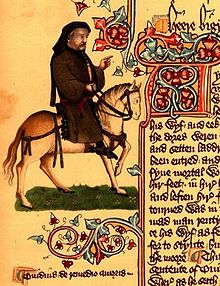
Geoffrey Chaucer Hath a Blog

Who knew! Or rather, who kneweth that the greate Chaucer hath himselfe written a blog?

I came across this website by accident yesterday and spent longer than I had anticipated trawling through it: http://houseoffame.blogspot.com/

The blog site includes several timely blogs, as well as links to pertinent information about Chaucer. But it’s the blogs that I particularly enjoyed, such as this one, “Aye, Virginia, ther ys a Robin Hood” (excerpt from http://houseoffame.blogspot.com/2010/06/aye-virginia-ther-ys-robin-hood.html):

“Deere Mayster Chaucer,

“Ich am but VIII yeeres of age. Sum of my litel freendes seyen that ther ys no Robin Hood. Ywis, thei do saye that ther is no historical record of him. My fadir sayeth that “yif ye see yt on a blog then it ys trewe.” Plese speke the treweth to me on yower blog: is ther a Robin Hood?

-Virginia

“Virginia, yower litel freendes aren yn the grip of grete errour. Thei have been bismotered by the over-reliaunce on documentz of a tyme that ys excessifly concerned wyth historical record. Thei yive credence unto no thyng but yif thei see yt in a roll or chartir or heare a twentye minute talke yn a small room wyth questionez aftirwardes. Thei thynk that no thyng can be or hath been save for thos thinges that kan be compassid in their croniclez. Yet all croniclez, whedir thei be of thos folk at gret researche universitees or thos term papirs that childer do wryte, are litel. In the grete duracioun of eternitee, the tyme of man ys but that of a pissemyre, whanne comparisoun ys made bitwene yt and the lastingnesse of the worlde. For as wyse Boece saith of erthely fame: “yif thou wolde make comparisoun to the endles spaces of eternyte, what thyng hastow by whiche thou mayest rejoisen thee of long lastynge of thy name?” (LIBER II PROSA VII).”

And the “Serpentes on a Shippe” blog is worth reading, as well.

Go ahead, get your Chaucer on! And be sure to check out his About Me page! Fun stuff.

Oh, the Pain!

So, I had to pare down my possessions in a big way this week, preparing for our move to Brazil. Didn’t think we owned that much. What naiveté! Now, having sold or given away two couches, a coffee table, an enormous (and comfy) easy chair, patio furniture, a baker’s rack, a file cabinet, a bookcase, a desk, etc., I feel free of all of these things. They were just things that we had come to own over the past 19 years.

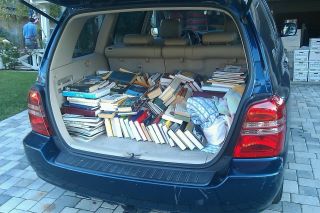
But the hard part was giving away (to the local library) about half of my book collection. I love books. I read them voraciously, and hold on to the books that I’ve greatly enjoyed and many that I intend to read again. I love to collect all the works of favorite authors. I buy mostly hardback books, because I want to support the authors who worked so hard to write the books. But hardbound books weigh a ton! I would guess that I had 400 books, guessing low. I own half whatever I owned before. Gave away 40 Trader Joe’s bags worth of books first, then took a backend-of-a-Highlander load to the library this week.

My books! I am an aficionado of e-books these days, but how I love real books! I’ve collected them all of my life! In fact, I still have the first books I owned as a child. Every time my dad got orders to move (he was an Army Engineer), I would get one box to fill with my stuff. From the age of nine, I saved many of my favorite books. In the past three years, I’ve passed along so many books that I’ve lost count, but I’ve kept these childhood friends.

I also kept my collection of books by PD James and by Meg Gardiner. These mean too much to me to let them go. I also kept a couple of my Dostoevsky books, but not all of them. That man wrote TOMES! Many other authors I had to let go, despite owning all of their series (Lee Childs, Zoe Sharp, Dick Francis, Robert Crais). It was like cutting off limbs.

I know they’re just books. People tell me that all the time. But they are so much more than the paper and cardboard of which they are made. They’re also friends, and portals to adventure and other worlds, and solace and relaxation.

I guess that for the next few years of my life, I will buy few physical books and concentrate on e-books. But it just won’t be the same. I can’t curl up with an e-book and stroke its spine and feel the joy of opening to the first page. But, I digress. It’s e-books for the nonce. (But, I swear, some day…I will buy books again!)


Upheaval

How many synonyms are there for the word “upheaval”? Let’s see. Off the top of my head, I know: upset, unrest, mayhem, catalyst, disorder, chaos. Then there are:  disruption, disturbance, trouble, confusion, turmoil, pandemonium, cataclysm, shakeup, debacle, revolution, change, and craziness.

The last one suits me best now, as our lives are upheaved during this time of change, as we move from San Diego to DC and then on to Brazil. This is a shakeup of epic proportions, already incorporating a sense of unrest, disorder, and pandemonium. Not quite a debacle, because I think we have things slightly under control, but with any further disruption or disturbance, I’m sure chaos will ensue.

Meanwhile, I will not be writing on this post for a week or so, as I have to unplug and box my life.

Until then, I’ll try to avoid the confusion that comes with upheaval, and walk placidly among the change.


Portuguese to Expand My Vocabulary

So now that I will soon be moving to Sao Paulo, Brazil, I have to learn Portuguese. I already speak French, know some German, and understand Spanish, but I hear that Portuguese is a whole new kettle of fish.

I’m looking forward to learning it, though, because each language I learn increases my English vocabulary, since English is a compilation of Romance languages, Latin languages, and a whole collection of words from other languages. Plus, as I learn Portuguese, I’ll learn new ways to phrase and describe things, rather than simply translating English into Portuguese. Transliteration doesn’t always work, as JFK found out while standing at the Berlin Wall, stating in German, “Ich bin ein Berliner.” What he meant was, I am a citizen of Berlin, but what he said was, I am an eclair. Or my father, when he once stated, “Je suis embarrasse,” to a roomful of nuns, who laughed behind their hands in silent hilarity. What he meant was, he was embarrassed. What he said was, he was pregnant.

So, it’ll do me good to learn a new language, both to apprehend what people in Brazil are saying to me, but also to expand my English vocabulary and descriptions. As I study, I’ll be sure to write some fun tidbits here. So keep an eye out!

Person of Interest

I was delighted to read that Jim Caviezel, best known for his role as Jesus in Mel Gibson’s “Passion of the Christ,” is now starring in a TV show, “Person of Interest.” It’s about time. Caviezel is an intense actor with a talent that might prove too big for television. I hope not. I’d look forward to watching him every week.

The premise of the show is intriguingly new. Kind of a crime-focused “Early Edition.” Caviezel  (along with Michael Emerson, another compelling actor who brings instant trust to his role) tries to stop crimes before they occur, and after they have been meticulously planned. After watching the premier of the show, I think it has real potential, as long as the writers stick to their game plan and pursue this story idea. As long as they don’t decide to change the premise and just make it another cop show.

I watched “Harry’s Law” last season, well the first half of the season, but then gave up when I found I couldn’t care less about the characters, except for Harry (played by Kathy Bates). Last week, I saw it was on for a second season, and turned to watch, to see whether they had improved the writing and plots. Lo and behold, now it’s just another lawyer show, a cookie-cutter replica of all of the other law shows on TV. They couldn’t make the original idea work, so instead of working harder to make something new succeed, they changed the premise, got new characters, and created a clone. So disappointing.

I understand. The producers want shows that work, that bring in sponsors. But once they’ve made the hurdle to get on TV, I wish they’d try harder to stick to their initial idea and make it work. I have high hopes for “Person of Interest,” but we’ll see how long it sticks to its premise and rises above the common surf. They have the actors, they had the writing in the pilot episode; let’s hope they have the writing and guts to press forward as something new, and succeed.

Copyediting Style Sheets

I cannot emphasize enough the importance of using style sheets if you are an editor. I created style sheets for myself before I even knew they were commonplace for editors. There is simply no other way to keep track of proper spellings, names, punctuation decisions, and other items that require consistency when you are editing. Before a manuscript is sent for final proofing, most publishers will require a style sheet. You might as well be the one to create it.

For my work, I use a two-level style sheet, one with formatting, punctuation, and spelling decisions in the top portion, and with an alphabetical list of words in the bottom portion. The alphabetical list allows me to quickly find and verify the spelling of any unusual or foreign words or proper names I find in the manuscript.

In the top portion, I write whether I’m editing for UK or US English (depends on the publisher), decisions about whether and when to spell out numbers (use words for one through ten, for example, and numerals for 11 and up), whether or not to use serial commas, how to cite sources in text and bibliography, punctuation (such as how to form an ellipse), and other items that must be consistent throughout the document.

With respect to names, I suggest that, even if you think the name is easily recognized, you write down the spelling, since authors sometimes change spellings in midstream. And always verify names against the bibliography, if one is included. (If there is a discrepancy, check Google to verify the author’s name.)  I alphabetize by first name, last name (i.e., Richard Johanson) rather than by reverse order (i.e., Johanson, Richard), as you’d find the name in the Index.

Speaking of indexes, the style sheet is also an aid when you are creating an index, since you already have many of the topics and names listed. Using the style sheet, you can search for terms in the manuscript and record the page numbers (in a PDF file, prior to print).

Of course, initially, keeping a style sheet as you edit adds time to your endeavor, but in the long run, it saves time, so you don’t have to keep flipping back through the pages to verify how something is spelled. This is especially helpful with history books or books about foreign topics, where names are vital.

I strongly recommend that you create a style sheet for yourself and your client when you are editing a manuscript. Most publishers require one, and it’s a nice little bonus to give to your clients before they ask for it. Once you get the hang of using them, you’ll wonder how you ever did without them.

Great Ideas, Poor Execution

About a month ago I wrote about SyFy’s new show “Alphas,” thrilled with the idea of the characters and eager to see what the writers did with the show. Now, two months or so into the season, I’m still waiting for the writers and directors to do justice to what they’ve created. They have this unique idea about a group of “common folks” with uncommon abilities, and they’re turning the show into a retread of “Heroes,” and a weak retread at that.

I sat and analyzed why it was so weak and decided it was because the writers just don’t know what to do with the characters they’ve created. The character who can influence people’s minds? She’s just an enforcer, who steps in when violence isn’t desired or necessary to get a confession or information. The empath? Well, she’s a little more useful, though she often seems more like a bloodhound than an empath. The former FBI agent who goes ballistic on command? Seems like he fails in his goals more often than he succeeds. The character with pinpoint aim? Certainly, he can throw a textbook and trip a running goon, but what else is he capable of doing? So much more! The character who reads/sees digital information is the most enjoyable, and yet they could do much more with him than have him track cell phone signals or read Google maps in the ether. And, finally, the fellow who has brought them all together…he caved so suddenly when the government wanted them to become “super agents” that he no longer has any credibility. What was the initial reason for gathering the Alphas? Does anyone remember?

Another show that had great promise but has withered on the vine is “Leverage,” about a group of con artists and thieves who help those who can’t help themselves, standing against all odds for the Little Guy. Unfortunately, Timothy Hutton is incapable of headlining the team with any strength of character; he’s the weakest link in the group of six. That’s likely due to his acting limitations, rather than to the writing, but the storylines have grown increasingly absurd and uninteresting. The season’s opener involving a mountain climbing expedition was laughably horrible. The Brits were able to keep the audience’s interest in the original series, but here in the U.S., the potential has fizzled.

Such a disappointment to see how these characters in both shows are going to waste. They have such potential for new storylines, but instead seem simply to be retelling stories from other shows using different characters.

The same goes for the second book in the Cleaner series by Brett Battles. In the first book, The Cleaner, Battles introduces us to an interesting character unlike any I’ve encountered before. The Cleaner sanitizes scenes where government/CIA/Office interactions have gone bad, removing bodies and covering any tracks of what took place. An intriguing idea, and I looked forward to reading more  books. The second book, The Deceiver, is so slow-moving that I found it hard to read until the end (though the last 50 pages finally picked up the pace). And in the second and third books, the Cleaner is no longer cleaning, but is involved in international intrigue on his own. We already have those characters and those stories.

Not that these books aren’t decent reads, but I get the sense that Battles has lost sight of the character he created, a new character with great potential for new stories. It’s sad to see a writer (or series writers) create something new and let the characters lie fallow, instead taking the easy/safe/tried-and-true path that has worked for other authors and writers.

I’ll keep watching “Alphas” for a few more episodes, though I’m almost certain I’m finished with “Leverage,” and haven’t decided on the Battles books.

The moral of the story is, it accomplishes nothing if you create great characters and let them go fallow in weak stories. Do justice to your characters and give them vehicles in which they can thrive.